
Martin Taraz
I am a PhD student with Patrick Baudisch at Hasso Plattner Institut (HPI). My PhD is in digital fabrication, a subfield of human-computer interaction. My goal is to develop the world’s first self-calibrating laser cutter, i.e., machines that reliably produce the highest-quality results—while requiring neither a technician nor user expertise, as my prototypes eliminate the need for manual calibration, trial-and-error, and asking for expert help. I achieve this by developing custom calibration hardware devices based on multiple custom sensors and actuators that attach to laser cutters. These devices run systematic, automated, closed-loop sequences of tests: They cut material, observe the outcome using cameras, assess the results, and finally apply the resulting insights to the model and the laser cutter. On top of these, I write software systems and finally conduct user studies. The intended impact of my work is to expand laser cutting beyond makers and technology enthusiasts and towards a mainstream audience.
I just returned from my internship with Maneesh Agrawala at Stanford University, where I was working on 3D Model Verification using a Domain-Specific Language synthesized with Large Language Models.
martin.taraz@hpi.de
curriculum vitae | scholar | bio
Full Papers at CHI / UIST
-
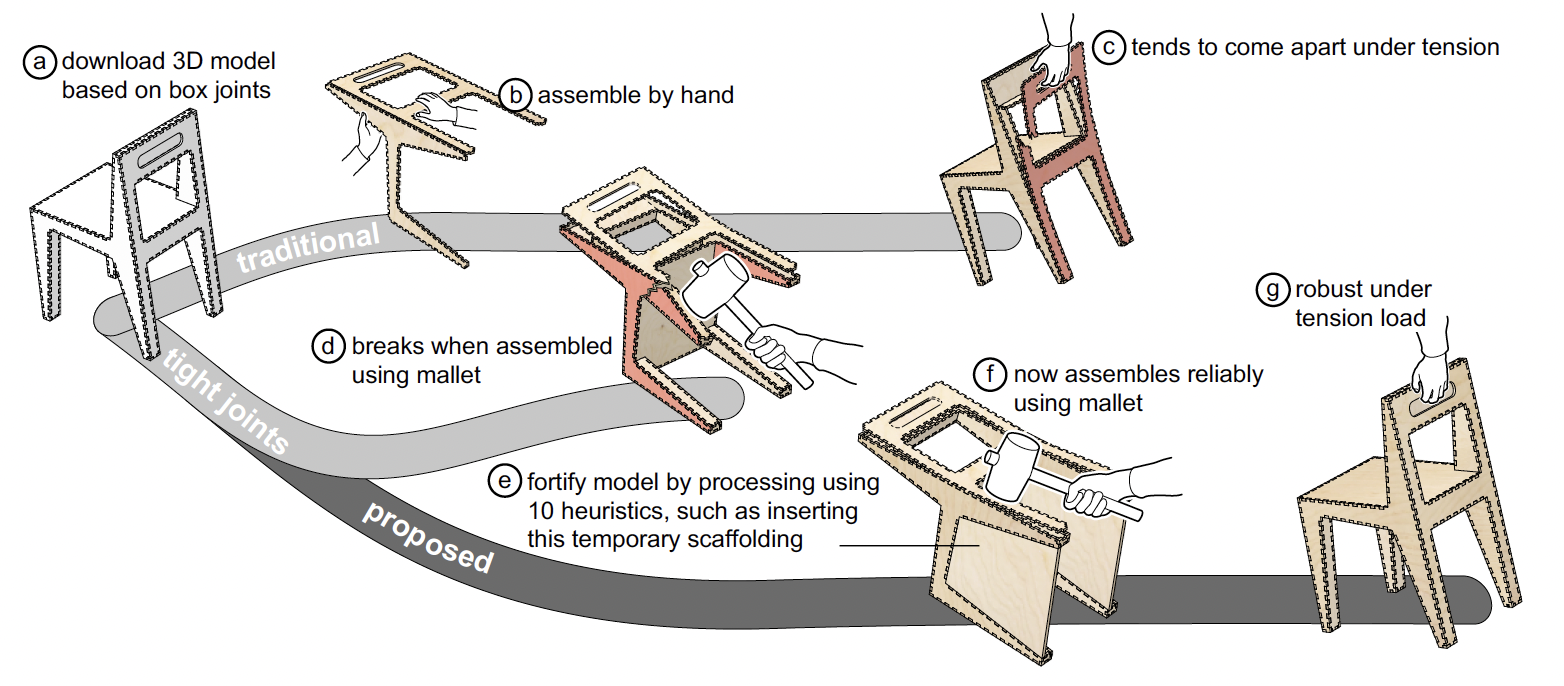
In Proceedings of UIST'25 (full paper)
Laser cutting has a long tradition of building load-bearing 3D objects based on box joints and T-joints, as these joints are naturally robust against compression and shearing. Achieving robustness against tension, however, is challenging. One presumed solution is to make all joints extremely tight, to the point where they can only be assembled using a mallet. However, our survey found that making joints tight can cause models to break during assembly. In this paper, we identify the 10 underlying issues and present techniques for overcoming them: by extending parts with what we call scaffolding or by adjusting the models’ assembly order, so as to bypass states that are subject to these issues. Fixing these issues speeds up assembly and reduces assembly effort.
-
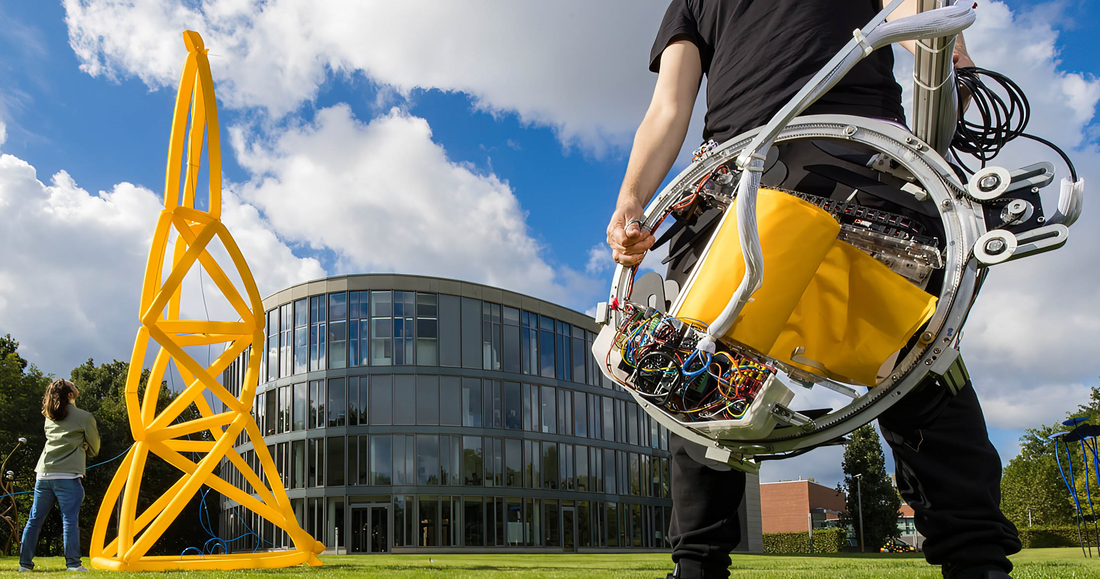
In Proceedings of UIST'23 (full paper)
We present AirTied, a device that fabricates truss structures in a fully automatic fashion. AirTied achieves this by unrolling a 20cm-wide inflatable plastic tube and tying nodes into it. AirTied creates nodes by holding onto a segment of tube, stacking additional tube segments on top of it, tying them up, and releasing the result. The resulting structures are material-efficient and light as well as sturdy, as we demonstrate by creating a 6m-tower. Unlike the prior art, AirTied requires no scaffolding and no building blocks, bringing automated truss construction into the reach of personal fabrication.
-
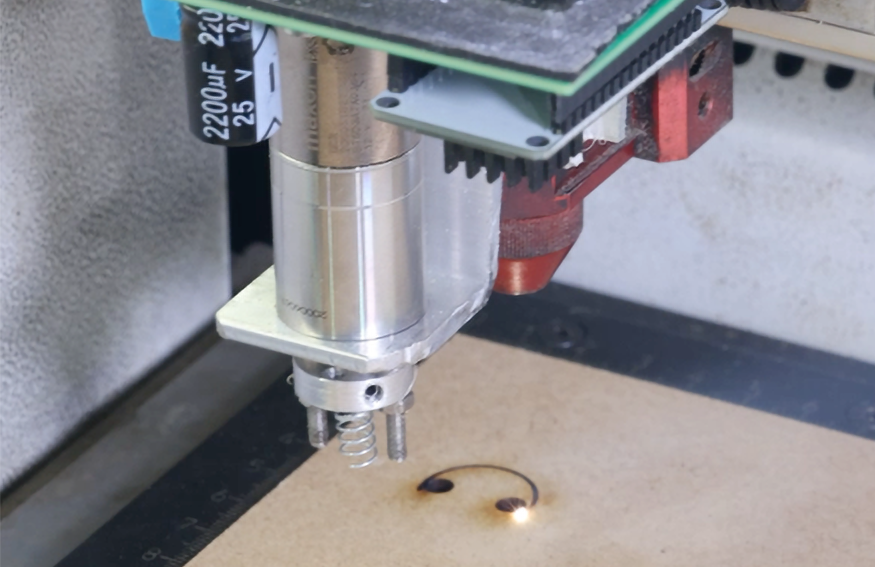
In Proceedings of CHI'23 (full paper)
Kerfmeter is a hardware + software device that automatically determines how much material the laser cutter burns off, also known as kerf. Its knowledge about kerf allows Kerfmeter to make the joints of laser cut 3D models fit together with just the right tension, i.e., loose enough to allow for comfortable assembly, yet tight enough to hold parts together without glue—all this without user interaction. Kerfmeter attaches to the head of a laser cutter and works as follows: when users send a model to the laser cutter, Kerfmeter intercepts the job, injects a brief calibration routine that determines kerf, dilates the cutting plan according to this kerf, and then proceeds to fabricate the cutting plan. Kerfmeter makes it easy to sample repeatedly; we demonstrate how this allows boosting precision past any traditional kerf strip.
-
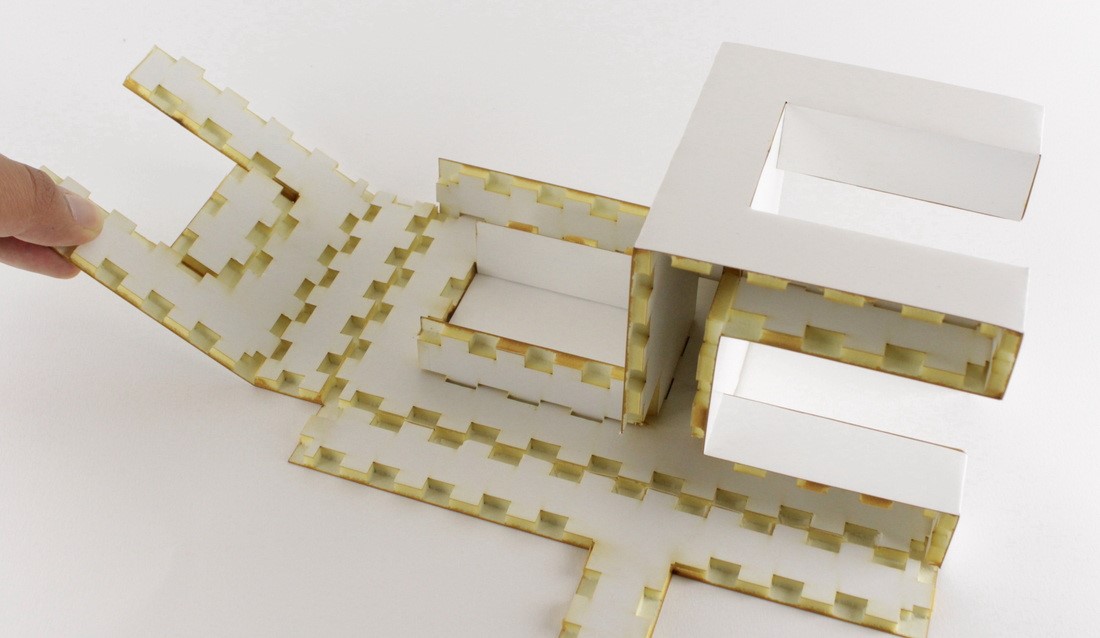
In Proceedings of UIST'22 (full paper)
HingeCore is a novel type of laser-cut 3D structure made from sandwich materials, such as foamcore. The key design element behind HingeCore is what we call a finger hinge, which we produce by laser-cutting foamcore "half-way". The primary benefit of finger hinges is that they allow for very fast assembly, as they allow models to be assembled by folding and because folded hinges stay put at the intended angle, based on the friction between fingers alone, which eliminates the need for glue or tabs. Finger hinges are also highly robust, with some 5mm foamcore models withstanding 62kg. We present HingeCoreMaker, a stand-alone software tool that automatically converts 3D models to HingeCore layouts, as well as an integration into a 3D modeling environment for laser cutting (kyub). We have used HingeCoreMaker to fabricate design objects, including speakers, lamps, and a life-size bust, as well as structural objects, such as functional furniture.
-
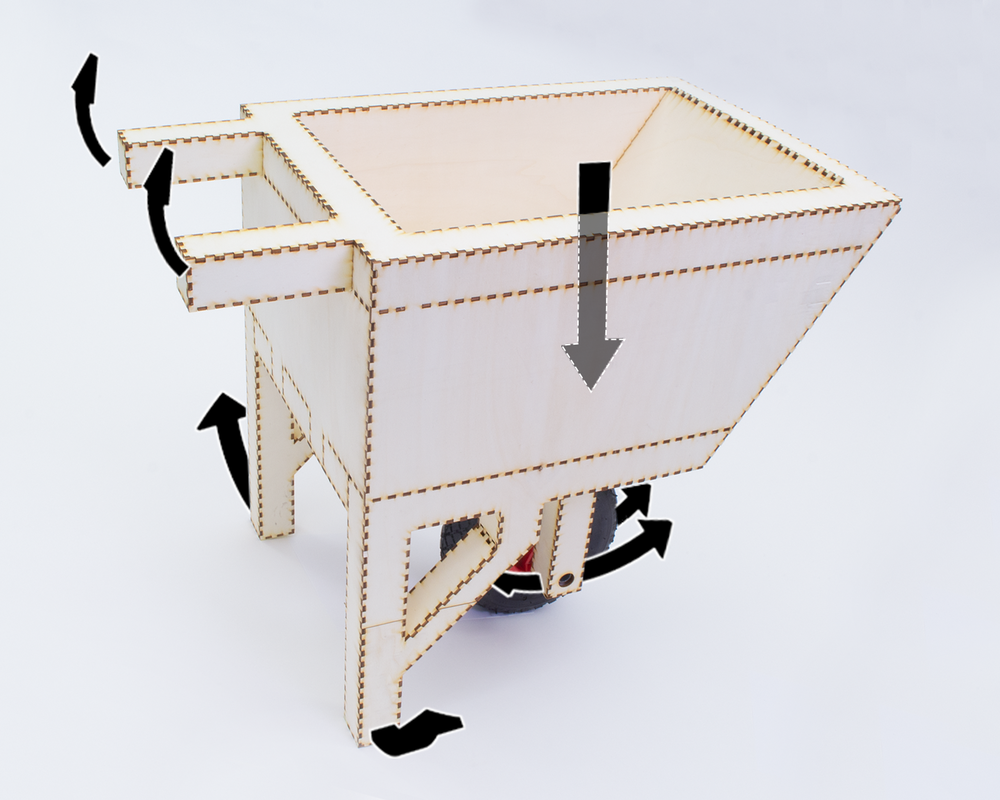
In Proceedings of CHI'21 (full paper)
FastForce is a software tool that detects structural flaws in laser cut 3D models and fixes them by introducing additional plates into the model, thereby making models up to 52x stronger. By focusing on a specific type of structural issue, i.e., poorly connected sub-structures in closed box structures, fastForce achieves real-time performance. This allows fastForce to fix structural issues continuously in the background, while users stay focused on editing their models and without ever becoming aware of any structural issues.